5 Google Search Algorithm Milestones Every SEO Beginner Should Know
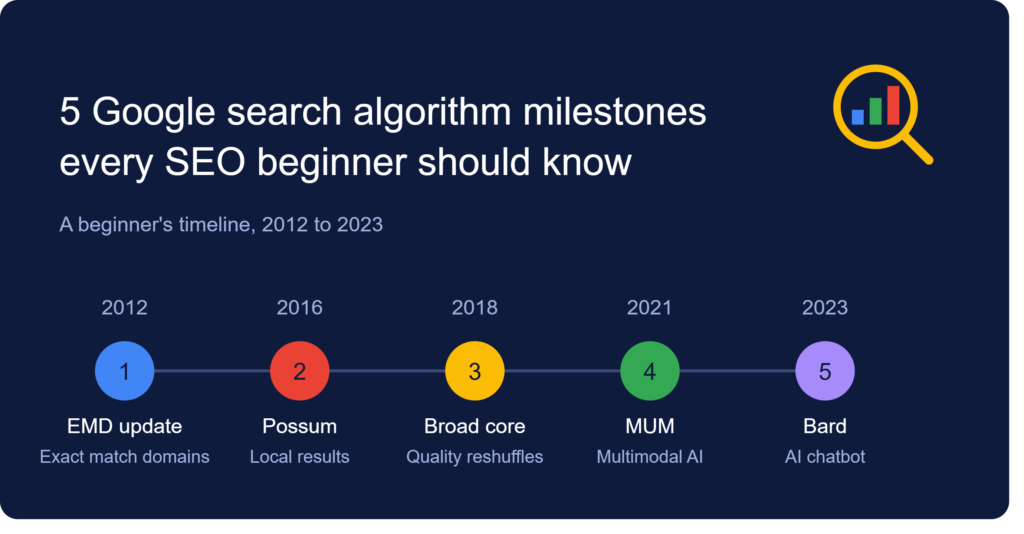
Introduction: Google Search is constantly evolving
The way websites appear in search results today is shaped by numerous systems that help Google understand what people are looking for, evaluate webpage relevance, and identify useful information. Some developments have improved Google’s understanding of complex language, while others have changed how local businesses appear or how websites are evaluated.
It’s critical for website owners and digital marketers to comprehend these trends.
SEO isn’t simply about adding keywords to a page and waiting for traffic. It requires a clear understanding of search intent, useful content, user experience, and the factors that help a website earn visibility over time.
Let’s explore five important developments in Google’s search ecosystem and understand how each one influences modern SEO practices.
1. MUM:
Understanding Complex Search Queries (2021) MUM (Multitask Unified Model) is a Google AI model introduced in 2021. It was designed to understand complex questions that may require information from multiple sources. Unlike systems that focus on matching individual words, MUM can identify relationships between concepts and process information across languages and formats, including text and images. For example, someone planning a challenging hiking trip might need information about suitable equipment, weather conditions, and preparation. MUM was designed to help Google understand these connected needs rather than treating each question as completely unrelated. What it means for SEO: Create content that addresses the complete needs of your audience. Explain important concepts, answer related questions, and organize information logically. Instead of repeating one keyword throughout an article, focus on delivering meaningful information that satisfies the user’s search intent.
2. Bard:
The Move Towards Conversational AI (2023) In 2023, Google introduced Bard, a conversational AI assistant that allowed users to ask questions and receive generated responses. It could assist with tasks such as writing, brainstorming, explaining concepts, and summarizing information. Bard was later renamed Gemini as Google’s generative AI products evolved. Although Bard was not a traditional Google Search ranking algorithm, its introduction marked an important development in how people could discover and interact with information online. It also highlighted the growing role of conversational AI in search experiences. What it means for SEO: Make your content easy to understand, navigate, and verify. Use descriptive headings, answer questions directly, and support factual claims with reliable sources where appropriate. These practices help readers find useful information and can make your content easier for search systems to interpret. However, there is no guarantee that structured content will be selected for AI-generated answers.
3. Possum:
A Major Change in Local Search (2016) The Possum update, widely associated with September 2016, changed how local search results were filtered and displayed. One notable effect was that businesses located close to one another, or sharing certain business details, could be treated differently when Google selected listings for local results. The update also highlighted the importance of a searcher’s location. Two people searching for the same service from different areas might see different local businesses because proximity can influence local search rankings. For example, someone searching for a digital marketing agency in Calicut may see different businesses depending on their location and the relevance of each listing. What it means for SEO: Local businesses should maintain an accurate Google Business Profile, select appropriate business categories, keep their contact information consistent, and collect genuine customer reviews. Creating useful location-specific website content can also help potential customers understand where a business operates and what it offers. Remember that proximity is only one factor in local search. Relevance and prominence also matter.
4. Exact Match Domain Update:
When Keywords in Domains Lost Their Advantage (2012) Before Google’s Exact Match Domain update, some websites could benefit disproportionately from domain names that closely matched popular search queries. A domain such as bestshoesonline. An example might appear relevant to a search for online shoe stores, even when the website itself offered little useful information. In September 2012, Google announced an algorithm change intended to reduce the ranking advantage of low-quality exact-match domains. The update did not eliminate the use of keyword-based domain names. Instead, it targeted the unfair advantage that certain low-quality sites received from their domain names alone. What it means for SEO Choose a domain that suits your brand and is easy for your audience to remember. Relevant keywords can help communicate what a business does, but they cannot replace valuable content, a well-organized website, or a useful experience for visitors. A strong domain name may support branding, but long-term search visibility requires more than a keyword in the URL.
5. Broad Core Updates:
Reassessing Search Quality Google regularly releases broad core updates that change how its search ranking systems assess and rank content. Unlike updates designed to address a specific issue, core updates involve broader adjustments to the systems used to identify relevant and useful results.
These changes can cause a website’s rankings to rise or fall, even when the website owner has not made any recent changes. A ranking decline does not automatically mean that Google has penalized a website. Other pages may simply be considered more relevant or useful following the update. Google’s December 2020 core update is one example of this ongoing process.
What it means for SEO:
If rankings decline after a core update, examine your content objectively. Check whether it answers the intended question, provides sufficient detail, demonstrates first-hand experience where relevant, and offers a good page experience. Google’s E-E-A-T framework stands for Experience, Expertise, Authoritativeness, and Trustworthiness. These concepts help explain the qualities Google encourages in helpful content, although E-E-A-T itself is not a single ranking factor or standalone algorithm. Rather than making rushed changes in response to every ranking fluctuation, focus on improving the overall value of your website.
Conclusion
Google’s search ecosystem has developed far beyond simple keyword matching. Advances in language understanding, conversational AI, local search filtering, domain evaluation, and broad ranking systems have all influenced how people discover information online.